Total Pageviews

Showing posts with label 1.5 Entrepreneurs and Leaders. Show all posts

Thursday, 7 September 2017

Enterprise and Entrepreneurs

Welcome to Ian's A/S Business Studies Blog...


Enterprise:

In its simplest form, enterprise is the ability to turn an idea into a successful business.

The entrepreneur

Enterprise is carried out through the work of an entrepreneur.

Click on the picture:


An entrepreneur is someone who is prepared to take a risk and open a business, usually with the aim of making a profit.

The starting point for enterprise is creativity, do you think you have the right qualities to be a successful entrepreneur? 

Lets see.....


Think about it......

What could you put in the 'space' of a self driving car for the comfort, entertainment, working needs, education or other wants of the occupants? 


The success of an enterprise will be determined by entrepreneurial qualities.

More here.

Importance of risks and rewards: 


RisksRewards
  • Business failure
  • Loss of investment
  • Loss of personal assets
  • Bankruptcy
  • Profit
  • Challenge of being your own boss
  • Business growth and future profits


Opportunity cost:


This is an important business concept. 


Opportunity cost measures cost in terms of the next best alternative.

What was the opportunity cost of giving the girl his last Rolo?

Remember, when starting a business resources are likely to be limited. 

An entrepreneur must consider the opportunity cost of all spending decisions.

There is also non-monetary opportunity cost such as time away from the family.

Business choices and trade-offs:

Opting for one choice involves compromising another.

A company aiming for the highest quality may not be producing as many products as it could.


Risk versus reward is an important trade-off.

High risk may lead to high returns but could prove fatal to the business. 


The trade off between profitability and redecorating:

The trade off between building as many houses as you can and building high quality houses:
Motives for becoming an Entrepreneur:


Did Mark Zuckerberg create Facebook for the money? What do you think.


Do you know the difference between profit maximisation and profit satisficing?


Satisficing behaviour is an alternative business objective to maximising profits.

It means a business is making enough profit to keep shareholders happy or it's sufficient for investors to maintain confidence in the management they appoint.


Other objectives:

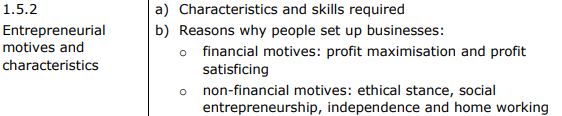
1. To run an 'ethical' business.

Click on the picture:


2. Independence.

3. Profit satisficing.

4. To run a social enterprise.


5. To be able to work from home.

https://twitter.com/i/status/1216638512990228481

Creating and setting up a business.                 


Where business ideas may come from:

The sources of ideas may include:

Brain-storming. 

Your own personal experience. 

Your business experience.


Examples of small business innovation here.

Intrapreneurship: 

Acting like an entrepreneur within a larger organisation. 

The term is derived from a combination of "intra" or internal, and "entrepreneurship."


Intraprenuers are usually highly self-motivated, proactive and action-oriented people who are comfortable with taking the initiative, even within the boundaries of an organisation, in pursuit of an innovative product or service.


The major difference between entrepreneurs and intrapreneurs is that any financial success default to the organisation rather than to the intrapreneur.

On the other hand, the intrapreneur also has the comfort of knowing that failure will not have a personal cost - as it would for an entrepreneur - since the organisation would absorb losses arising from failure. 


Government support for enterprise and entrepreneurs:

GOV.UK (Business Link) is a free online resource for businesses. 

It contains essential information, support and services for you and your business - whether you work for a large organisation or are on your way to starting up.

Socrative quiz:
Go to socrative student on your Smartphone and log in.
Enter Room: 151756.
Entrepreneurship: "good artists copy: great artists steal" (Steve Jobs)

Sources of business ideas


Observation:
Richard Hilton was a skinny 19 year old living in New York and working in advertising.


He wanted to bulk up to attract more female attention.

He joined a gym but only lasted three months.

Then he discovered Crunch:


"It was an insane environment" said Hilton.

Graffiti replaced the usual white walls.

Live DJs played every evening.

"One week I was doing boxing with with a class taught by Muhammed Ali's trainer, the next week it was taught by a drag queen who just happened to be a great boxer."

When Hilton returned to the UK he spotted a similar gap in the market.


The advertising was done through flyposting.

"It was illegal then; its even more illegal now" said Hilton.

The first poster had the following words in boxes connected by arrows:

Office affair

Need shower

Gymbox

Home sweet home

Next came a sign near local gyms stating 'better gym this way', with footprints leading to Gymbox.
Wikipedia entry: https://en.wikipedia.org/wiki/Gymbox 


Richard Hilton has retained a 20% share of the business.

How much did he receive for the other 80%?

Innovation Within a Business

               Creating and setting up a business.                 


Where business ideas may come from:

The sources of ideas may include brain-storming, your own personal experience and your business experience.


Examples of small business innovation here.

Intrapreneurship: 

Acting like an entrepreneur within a larger organisation. The term is derived from a combination of "intra" or internal, and "entrepreneurship."


Intraprenuers are usually highly self-motivated, proactive and action-oriented people who are comfortable with taking the initiative, even within the boundaries of an organisation, in pursuit of an innovative product or service.


The major difference between entrepreneurs and intrapreneurs is that the fruits of success default to the organisation rather than to the intrapreneur.

On the other hand, the intrapreneur also has the comfort of knowing that failure will not have a personal cost - as it would for an entrepreneur - since the organisation would absorb losses arising from failure.


Choosing the Right Legal Structure for the Business


Choosing the right legal structure:

Sole traders, partnerships, private limited companies and public limited companies.

You need to learn definitions, advantages and disadvantages of each type of legal structure. 

You could start here.

Find this video and I will be well impressed.


 https://youtu.be/U4QvPXvNKj0

There are some good notes on this topic from this website.

Franchising:

A business which has bought the right to trade under the name, logo and trading method of an existing (hopefully) successful business.

Click on the headline:

To obtain a franchise requires the payment of an initial fee and the signing of a contract that places the following restrictions on the franchisee:
The layout and design of the premises is controlled by the franchisor.

All supplies have to be bought from the franchisor.

An annual payment to the franchisor – a % of the franchisee’s sales revenue (income).

The owner of the business idea is called the franchisor and the person who wants to run the franchise is called the franchisee.

Advantages and disadvantages of franchising and more from the Ashbourne College blog here.

Texas chicken - the next big thing?


Social enterprises:

Social enterprises trade to tackle social problems, improve communities, people's life chances, or the environment.

They make their money from selling goods and services in the open market, but they reinvest their profits back into the business or the local community. 

And so when they make a profit, society benefits.

Click on the picture:

http://www.socialenterprise.org.uk/about/about-social-enterprise

Lifestyle businesses:

A lifestyle business is a business set up and run by its founders primarily with the aim of: 

Providing a foundation from which to enjoy a particular lifestyle.


Online businesses:

An online business is any business on the Internet that sells products, services, or advertising, online.

Advantages and disadvantages of this type of business here. 

Growth to Public Limited Company (PLC) and stock market flotation:

Many successful private limited companies (ltd) decide to 'go public' and become public limited companies (plc).

The process is technically called a 'flotation' as in the UK the shares are 'floated' on the London Stock exchange.

Why?

The process can raise vast amounts of money to help the business reach its objectives.


It can also make the original owners very rich.

Click here.


Advantages / disadvantages of a stock market flotation. Details here.

Link to the London Stock Exchange. Details here.

Socrative quiz:


Go to m.socrative.com on your Smartphone.
Enter Room 151756.

Business Objectives


An aim is where the business wants to go in the future. 

It is a statement of intent, e.g. we want to rapidly grow the business. 

Business objectives are the stated, measurable targets of how to achieve business aims. 

For instance, we want to open 30 new branches by 2018.

A) Survival

This is particularly important to a new business start up seeking to build a customer base.

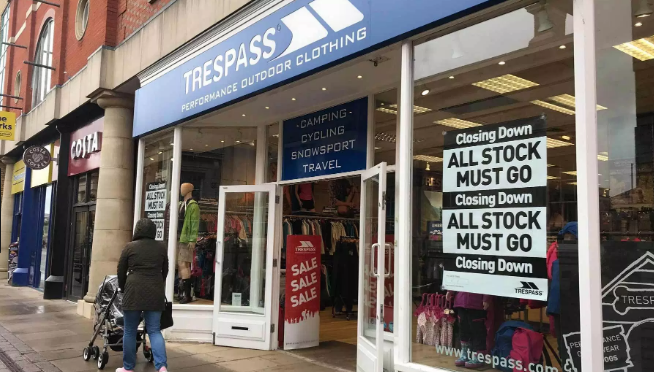
However.... there are times when an existing business may face challenges.

- An economic downturn or recession.


- Changes in consumer demand

Click on the picture:

http://news.bbc.co.uk/1/hi/programmes/politics_show/7754505.stm

- Competition

Click on the picture:

http://www.mirror.co.uk/news/world-news/hundreds-mcdonalds-fast-food-restaurants-set-5572840
B) Profit maximisation

Click on the picture

http://fortune.com/2015/06/11/fortune-500-most-profitable-companies/

C) Other objectives:

- Sales maximisation

- Market share

- Cost efficiency

- Employee welfare

- Customer satisfaction

- Social objectives

Barriers to Entrepreneurship

Main obstacles and barriers when starting a business:

1. Cultural barriers


Not everybody has the ability to take a risk - many people value the security of a good job or regular income. 

Why do you think this is?

Entrepreneurship can lead to failure.


Does society view failure as a mistake? 

Do you think this acts as a barrier to enterprise?

2. Lack of knowledge or experience.

What skills do you need to become a successful entrepreneur?

Where and how would you learn them?

3. Rules, tax and legislation.

For example - running a business from home. Details here.

4. Financial barriers.

If you do not have the necessary finance - what can you do?

Other Motives for Entrepreneurial Activity

1. Seeking to run an 'ethical' business which can also make a profit.


'Doing the right thing' is very important for some entrepreneurs.

They wish to provide society with a product or service which:

Is beneficial for their customers.

Does not harm the environment.

Does not exploit employees, suppliers or the local community.

You could probably add to this list.

Poco restaurant in Bristol produces as little waste as possible.

They aim to recycle or compost 95% of the daily restaurant waste, use local suppliers (even telling customers the name of the boat that caught the fish they are eating) and seasonal food, and campaigns suppliers to use less packaging. 

More details here.

Elvis and Kresse: What do you think this bag is made of?
 http://elvisandkresse.com/
Click on the picture and see 'Our Story' at the bottom of the page.

2. Social entrepreneurship.

Using entrepreneurial skills to generate a 'surplus' which could be reinvested to support the social enterprise.


Name of Social Enterprise: The Big Issue

Cause: Support financially homeless people
Business model:

The Difficulties in Developing from an Entrepreneur to a Leader.


At some point the entrepreneur has to pass power and authority to managers because the scale of the companies operations has made it impossible to manage it alone.

The entrepreneur needs to become a leader.

Possible problems:

1. The need for shared ownership.


Entrepreneurs are likely to begin as sole traders. 

As businesses grow they will require more capital.

This means the entrepreneur will probably have to invite new owners to contribute this money.

2. Greater responsibility to others.

As a business grows the 'leader' has greater responsibility to staff, shareholders and other stakeholders.

3. The need to motivate and inspire.


4. The need to develop strategy and vision.


5. Loss of control.

A business may grow to be very large, very quickly and the leader fails to grasp important aspects of company operations.


'Six strikes and you are out'.

Zero hour contracts.

End of day searches which could take 20 minutes.