https://youtu.be/qmS6HtQdO0k

Other businesses tend to have a more formal organisational structure.
Organisational structure
This refers to the relationship between different people and functions in an organisation.
Vertically, from shop-floor workers through supervisors and managers to directors.
Horizontally, between different functions and people at the same level.
Organisation chart:
A diagram showing the lines of authority and layers of hierarchy in an organisation.

An organisational chart of Thorpe Park:

Organisational hierarchy
The vertical division of authority and accountability in an organisation.
Levels of hierarchy:
The number of different supervisory and management levels.
Span of control:
The number of subordinates a manager is required to supervise directly.
If a manager has many subordinates answerable to him or her, the span of control is said to be wide.
If a manager has relatively few subordinates answerable to him or her, the span of control is said to be narrow.

Normally, the greater the degree of similarity in what a group of workers do, the wider the span of control can be.
Chain of command:
The chain of command is the formal line of authority, communication, and responsibility within an organisation.
Traditionally, organisations tended to have very tall hierarchical structures, i.e. many layers of management, each with a narrow span of control.
More recently, hierarchies have become flatter, meaning that the number of layers of management has been reduced and each manager has a wider span of control.
 Centralised / decentralised.
In a centralised organisation power and authority come from head office.
All significant decisions are made from the centre.
Click on the picture:

Advantages of a centralised approach:
Consistency.
Consumers like the fact that they know what the product or service will be like.
Buying can be centralised, saving money through economies of scale.
Disadvantages of a centralised approach:
Managers at head office may not be aware of local trading conditions.
A lack of decision making may demotivate branch managers.
Decentralisation involves delegation.
Delegation

The process of passing authority down the hierarchy from a manager to a subordinate.
Subordinates must be appropriately skilled, trained and informed about the particular task they will be responsible for.
Advantages of Delegation:
It frees up time for managers to concentrate on strategic tasks.
It empowers and motivates workers.
Subordinates might have a better knowledge of local conditions and therefore might make more informed decisions.
Disadvantages of Delegation:
The actions in one branch could damage the reputation of the brand.

Some staff may not be able to handle the responsibility.
In crisis situations it may not be appropriate.
Some staff may abuse the responsibility that they have been given.
Communication:
Communication is the process of exchanging information or ideas between two or more individuals or groups.
Internal communication: exchange of information that takes place within an organisation (e.g. at departmental meetings, in team briefing sessions and in memos to staff).
External communication: exchange of information that takes place with individuals, groups and organisations outside the business (e.g. via advertising material, telephone calls to suppliers and letters to customers).
Two-way communication ensures that any communication has been fully understood and is therefore more effective than one-way communication.
Effective two-way communication is a vital element of democratic management, effective delegation, empowerment and teamwork.
More details on this topic here.
Socrative quiz:

Go to: m.socrative.com on your Smartphone.
Enter room: 151756 and give your team a name.

Other businesses tend to have a more formal organisational structure.
Organisational structure
This refers to the relationship between different people and functions in an organisation.
Vertically, from shop-floor workers through supervisors and managers to directors.
Horizontally, between different functions and people at the same level.
Organisation chart:
A diagram showing the lines of authority and layers of hierarchy in an organisation.
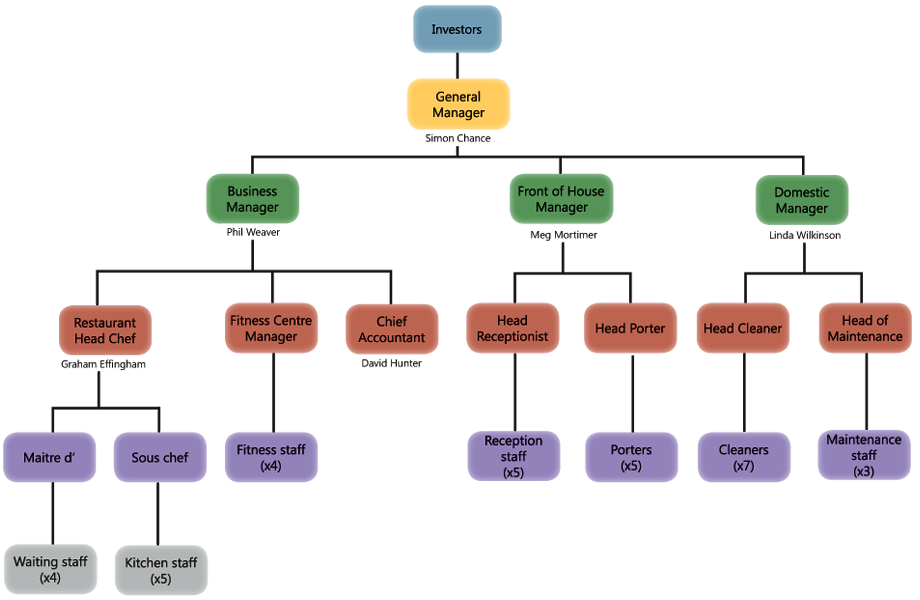
An organisational chart of Thorpe Park:

Organisational hierarchy
The vertical division of authority and accountability in an organisation.
Levels of hierarchy:
The number of different supervisory and management levels.
Span of control:
The number of subordinates a manager is required to supervise directly.
If a manager has many subordinates answerable to him or her, the span of control is said to be wide.
If a manager has relatively few subordinates answerable to him or her, the span of control is said to be narrow.
Normally, the greater the degree of similarity in what a group of workers do, the wider the span of control can be.
Chain of command:
The chain of command is the formal line of authority, communication, and responsibility within an organisation.
Traditionally, organisations tended to have very tall hierarchical structures, i.e. many layers of management, each with a narrow span of control.
More recently, hierarchies have become flatter, meaning that the number of layers of management has been reduced and each manager has a wider span of control.

In a centralised organisation power and authority come from head office.
All significant decisions are made from the centre.
Click on the picture:
Advantages of a centralised approach:
Consistency.
Consumers like the fact that they know what the product or service will be like.
Buying can be centralised, saving money through economies of scale.
Disadvantages of a centralised approach:
Managers at head office may not be aware of local trading conditions.
A lack of decision making may demotivate branch managers.
Decentralisation involves delegation.
Delegation

The process of passing authority down the hierarchy from a manager to a subordinate.
Subordinates must be appropriately skilled, trained and informed about the particular task they will be responsible for.
Advantages of Delegation:
It frees up time for managers to concentrate on strategic tasks.
It empowers and motivates workers.
Subordinates might have a better knowledge of local conditions and therefore might make more informed decisions.
Disadvantages of Delegation:
The actions in one branch could damage the reputation of the brand.

Some staff may not be able to handle the responsibility.
In crisis situations it may not be appropriate.
Some staff may abuse the responsibility that they have been given.
Communication:
Communication is the process of exchanging information or ideas between two or more individuals or groups.
Internal communication: exchange of information that takes place within an organisation (e.g. at departmental meetings, in team briefing sessions and in memos to staff).
External communication: exchange of information that takes place with individuals, groups and organisations outside the business (e.g. via advertising material, telephone calls to suppliers and letters to customers).
Two-way communication ensures that any communication has been fully understood and is therefore more effective than one-way communication.
Effective two-way communication is a vital element of democratic management, effective delegation, empowerment and teamwork.
More details on this topic here.