In economics effective 'demand' is the willingness and ability to pay for a product.
The main factors affecting demand for a product or service: Price What is the 'demand curve' above showing? Prices of other goods Some products are substitutes and others are complementary goods. Substitute products:
If the price of one of these products increased the demand for the other is likely to increase. Complementary goods:
If the price of milk increased dramatically what would probably happen to the demand for cornflakes? Changes in consumer incomes. Goods such as cars and cinema tickets are called 'normal' products because demand will rise as peoples incomes rise. The demand for 'inferior' products will fall as peoples incomes rise. Can you see why demand for this product would probably fall as customers incomes were rising?
Fashion, tastes and preferences. Over time these are very likely to change.
Advertising and branding.
]
Demographics.
This involves a study of the population.
Certain trends are evident about the UK population over recent years. More elderly people. Increased migration, from Eastern Europe for example. An increased number of single people households. Demand for which products may change because of these trends? External shocks.
In a 'recession' demand for a range of products is likely to fall.
Seasonal variations.
Can you link the time of the year with either increasing or decreasing demand for a product?
Supply is the quantity of a product that a producer is willing and able to supply onto the market at a given price in a given time period.
Factors leading to a change in supply: 1. Changes in costs of production.
An increase in the cost of producing an item is likely to lead to a higher price. In turn this is likely to reduce sales and profits. A business is therefore likely to supply less to the market. 2. Introduction of new technology.
New technology will probably mean costs will fall. This would allow a business to supply more at the same, or lower price. 3. Indirect taxes. These are taxes on customers spending, the main one being Valued Added Tax (VAT). If indirect taxes were imposed or went up, prices would rise and customers would buy less.
Supply is therefore likely to fall. 4. Government subsidies. This is money paid by the government / European Union to help reduce costs in a particular industry.
Reduced costs in an industry is likely to increase supply. 5. External shocks. These could include: Poor weather conditions, typhoons, drought and war, tend to reduce crop yealds or the availability of of products such as oil which can lead to reductions in supply. Click on picture for video.
The actions of buyers and sellers should produce an equilibrium price in a market where demand and supply are equal.
The equilibrium price is also known as the market clearing price.
Where supply exceeds demand, because the market price is too high, there is a 'surplus' of product in the market.
Where demand exceeds supply there is a 'shortage' in the market because of low prices.
It seems that ticket prices for major sporting events may be being sold below the equilibrium price level.
This has created a shortage of tickets.
Equilibrium is where there is a balance between supply and demand.
At this point the price should be stable.
Shifts in demand:
The demand curve shifts to the right:
Demand has shifted to the right from D1 to D2.
This has caused a shortage at the current price, so that prices will rise and the equilibrium quantity will increase.
Why do you think this could have happened?
- A rise in incomes.
- A successful advertising campaign.
- A rise in the price of a substitute (competition).
- A fall in the price of a complement (such as an increased demand for tyres as the price of cars fall).
The demand curve shifts to the left:
Demand curves can also shift to the left for opposite reasons.
This leaves a surplus at the current price, so the price
will fall and the equilbrium quantity will fall.
The horsemeat scandal would have caused the demand for Tesco burgers to shift to the left.
Shifts in supply:
The supply curve shifts to the right:
This causes a surplus at the current price, so that prices will fall and the equilibrium quantity will rise.
Factors increasing supply and shifting the supply curve to the right:
Decreased production costs. New competitors enter the market. New technology. Very high crop yields.
The supply curve shifts to the left:
This causes a shortage at the current price, so that prices will rise and the equilibrium quantity will fall. Factors decreasing supply and shifting the supply curve to the left:
Increased production costs.
Withdrawal of market competitors. A poor harvest.
A combination of factors could cause both curves to move.
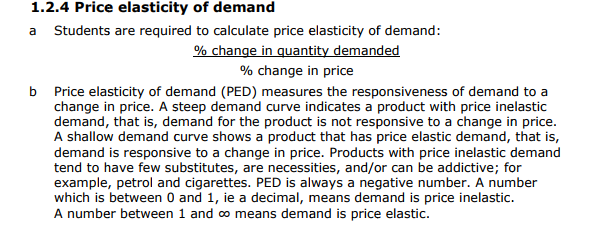
The responsiveness of demand to changes in price is measured by price elasticity of demand (ped). For some products a price change will result in a large change in demand and for others a smaller change.
Calculating price elasticity of demand:
Percentage change in quantity demanded
Percentage change in price
PED is always a negative number - but we ignore this.
Price inelastic demand:
When the result of the calculation is less than one.
The percentage change in demand is less than the percentage change in price.
An increase in the price of a price inelastic product will increase revenue.
A reduction in price will decrease revenue.
Setting a high price (skimming) is much more likely for a price inelastic product.
Products with price inelastic demand tend to have few substitutes.
They may also be necessities - petrol in rural areas, or addictive - cigarettes.
Price elastic demand:
When the result of the calculation is more than one.
The percentage change in demand is more than the percentage change in price.
If PED is price elastic an increase in price will reduce revenue.
However, lowering prices will increase revenue for a price elastic product.
Lowering price policies (competive pricing) are more likely when a product is price elastic.
Price elastic products would be expected in a very competitive market.
Unitary price elasticity:
When the result of the calculation is exactly one.
The percentage change in demand is exactly the same as the percentage change in price.
Influences on the price elasticity of demand:
Demand is likely to be more price inelastic if:
The product is heavily branded so customers are not especially sensitive to price changes.
There are few substitutes.
A relatively low proportion of income is spent on this product so customers are less sensitive to a price change.
For example, if your income increased by 5% and your demand for mobile phones increased 20% then the YED of mobile phones = 20/5 = 4.0
Unlike price elasticity, whether the result of the calculation is a positive or negative number is very significant.
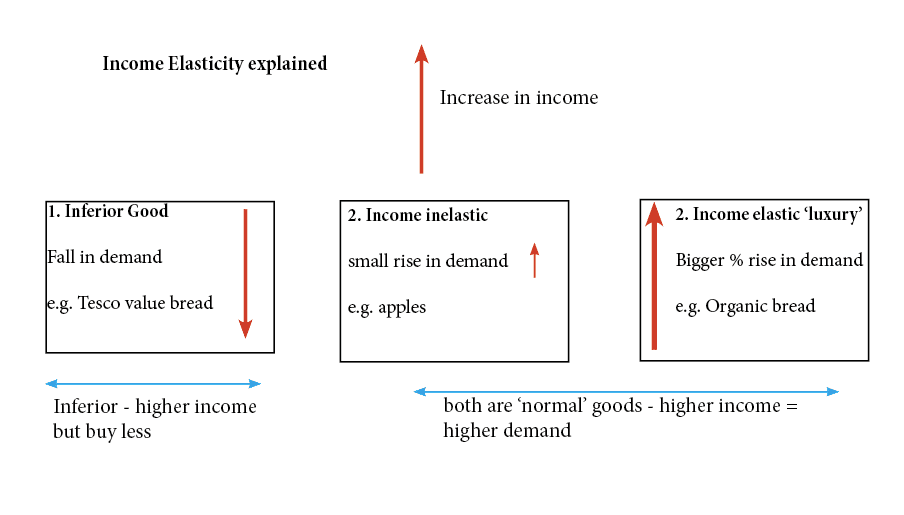
If an increase in income leads to an increase in demand (a positive + result of the calculation) this would be a 'normal' product.
If the value of income elasticity is negative - where an increase in income leads to a fall in demand - this would be known as an 'inferior' product.
Factors influencing income elasticity of demand:
Whether the product is a luxury, necessity or inferior product.
Expectations of changes in income such as job loss or promotion, recession or economic growth.
What does this suggest about income elasticity of demand for Laura Ashley?
Products can be Income Elastic or Income Inelastic (although both must be normal products with a positive + result from the calculation.) The factors influencing income elasticity of demand:
Necessities such as electricity will be income inelastic. (With a result from the calculation being in the range 0 - 1.0)
Luxuries tend to be income elastic. (With a result from the calculation being in the range 1.0+)
Definition of Inferior Good
This occurs when an increase in income leads to a fall in demand.
Other examples of inferior goods: clothes from charity shops, cheap bread.
Definition of a Normal good
This occurs when an increase in income leads to an increase in demand for the good, therefore YED is greater than 0.
Definition of a Luxury good:
When an increase in demand causes a bigger percentage increase in demand, therefore YED equals greater than 1.
For example, if your spending on Game Apps increases 25% after a 10% increase in income – this is luxury good; the YED = 2.5
Luxury goods will be income elastic with a numerical result greater than one.
Income inelastic. This means an increase in income leads to a smaller percentage increase in demand.
Using knowledge of income elasticity of demand:
Firms will make use of income elasticity of demand by producing more luxury goods during periods of economic growth.
In a recession with falling incomes, supermarkets might be advised to promote more ‘value’ inferior goods.